
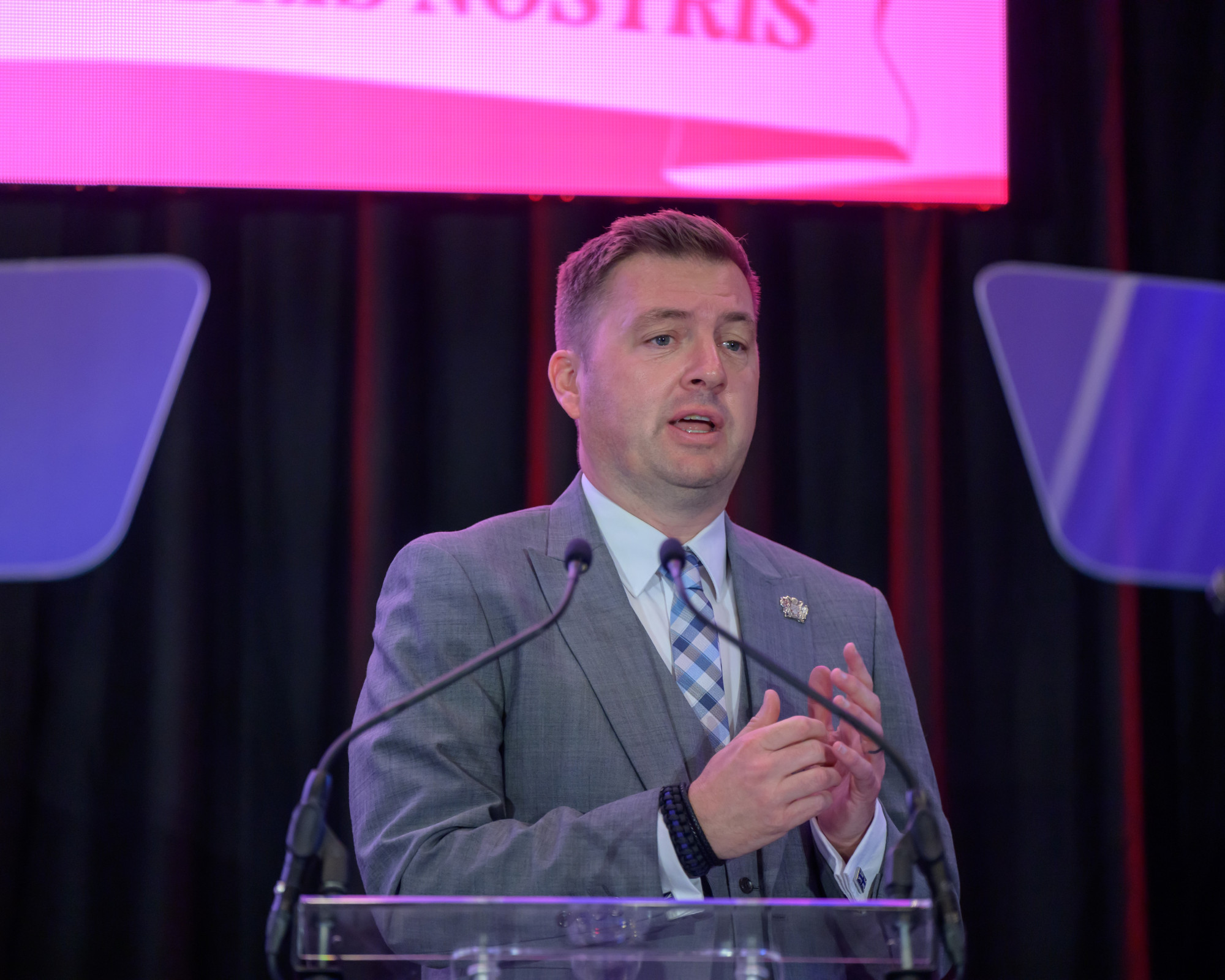
Rachel is a fictional officer, but her shift is not. In this year's conference speech, our Chair, Stuart Cowan, used our new film Non-Stop to highlight what BTP officers face every day: a missing child, a violent passenger, an angry crowd, a person in crisis and the toll of trauma, all with no time to recover between incidents.
The speech set out the pressures on our members, from wellbeing and assaults to misconduct processes, retention and pay. It welcomed progress in some areas and announces new Federation support, while calling on the Force, the Authority, and Government to do more. Read the full speech below.
Chair's Conference Address 2026
Good morning. Later today, you'll meet Rachel. Rachel is a fictional officer, but what happens to her on duty is not fiction. It represents what our members deal with on the railway every single day. We made a film about it. We called it Non-Stop.
When we screen that film this afternoon, you'll see Rachel deal with a fight on a train. You'll see her work to reunite a lost child with their parent; a rare moment of sheer relief in the middle of her shift. You'll see her abandon her lunch - again - because an urgent call comes in. You'll see her caught up in public disorder, narrowly avoiding injury. And ultimately, you'll see her do something most members of the public never think about, but that leaves a lasting impact on so many of my colleagues.
One officer. One hell of a workload.
I could stand here today and talk to you about the state of policing using graphs and figures. I will use some, because the numbers matter. But I wanted to tell you about Rachel first, because behind every statistic I'll share, there's a Rachel. Right now, somewhere on the rail network, a real officer is doing a real version of everything she does on screen.
That's what "non-stop" means. Not just busy. Not just demanding. Non-stop, incident after incident, with no time built in to process what you've just seen before you're needed for the next one.
So today, I want to talk honestly about the state of policing. The pressure our members are under, what's being done about it, what still isn't good enough, and what’s needed to change that.
Repeated exposure to trauma
Every officer in this room recognises Rachel's story, because you've lived a version of it.
What it highlights, and what the public rarely sees, is the sheer range of what's asked of a single officer in a single day. Safeguarding. Violence. Grief. Disorder. Public reassurance. All of it, back to back, with no recovery time in between. We don't get to leave one incident behind before we're called to the next. There's no debrief between the lost child and the urgent call. You just go.
That's the job. And it's why the pressure our members are under isn't a passing phase, or a bad month, or a difficult shift pattern. It is structural. It is constant, on repeat.
It is non-stop.
Let’s talk about what you don't see when you spot one of our colleagues at a station. The repeated exposure to trauma. The pressure to be unbreakable. The drive home in silence after a job that means you see and hear things no one should.
Sadly, more than 270 suicides and suspected suicides were recorded on the mainline rail network last year . Our members will have attended every one of those scenes. They were also deployed to the devastating attacks on passengers on a train in Huntingdon. The collision between two trains in Bedford. The recent derailment of a train in Lewes.
Then there are those incidents that don’t make the headlines. Physical violence, disorder, distressing safeguarding cases.
Wellbeing support is vital in policing. Officers face continuous operational trauma, physical dangers, and heavy workloads that can severely impact their mental and physical health. This Federation has previously, and very publicly, criticised BTP’s Occupational Health provision. But I am encouraged by the force’s investment in this area.
The recognition that one size doesn’t fit all seems to be making a difference, particularly for officers’ mental health. Figures from BTP suggest both long- and short-term mental health sickness is reducing. I appreciate it may not feel that way if you are one of those people who is currently struggling, but I genuinely hope we’re moving into an era where support is becoming more accessible, more impactful, and free of stigma.
We don’t want to see our members burning out. We don’t want their morale to be on the floor. We don’t want to watch them walk out the door because they’re stressed and feel they have no choice but to resign.
Or worse.
Suicide is an issue in the police service. Between 2011 and 2022, there were 242 suicides of current police officers and PCSOs in England and Wales. Like most forces, we have lost officers to suicide, and we all have a part to play in ensuring colleagues don’t seek a permanent solution to temporary problems.
Today I’m announcing that BTP Federation has signed up to the STEP campaign. The Suicide Trauma Education Prevention campaign was launched by Hampshire Police Federation in response to escalating officer suicides.
The suicide prevention app, Stay Alive, will be made available to our members. It provides tailored information for people in crisis and support for those trying to help others in crisis. And in line with the campaign’s aims, this Federation will work to raise awareness of suicide prevention and press for more support from police leaders.
Officers under attack
Every year I talk about the number of officers assaulted in the line of duty. It’s important, and I feel it indicates how some people view officers and the police service. As punchbags. As something to vent your frustrations on. No longer deserving of respect.
Last year,1220 assaults were recorded against BTP officers. That's an average of more than three per day, and it’s a number that keeps increasing, year on year. Every one of those officers went to work that day to keep the travelling public safe, and came home with a bruise, a broken bone, or worse. Risk is part of our job. Assaults should not be.
That's why we're welcoming BTP’s reinvigoration of Op Hampshire.
For those who don't know it, Op Hampshire exists to make sure that when one of our officers is assaulted, they are treated properly. That it's taken seriously, investigated thoroughly, and prosecuted properly, every single time. Not sometimes. Not when there's capacity. Every time.
Because an assault on an officer isn't "part of the job" in the way some in the system still seem to think it is. It's a crime, committed against someone doing their duty on behalf of all of us.
BTP tells us it is actively tracking Operation Hampshire cases across the force to improve oversight and support victims throughout the criminal justice process. This work has highlighted significant delays, with some cases now listed well into 2029 and beyond. I have raised this with both the Justice Secretary and the Victims Minister because it affects our colleagues’ wellbeing and morale, and has consequences for operational effectiveness and workforce resilience.
The Force also plans to refresh the Officer Assault Pledge and develop a communications strategy to increase awareness of Op Hampshire and the support available. I really want to see BTP deliver on these plans. This Federation will monitor progress closely, because this is important if we are to support and protect our own people.
Frustratingly, the Federation remains at arm's length when it comes to colleagues who have been assaulted. I want to be clear. A lack of response from us isn’t a sign that we don’t care. Most of the time, we simply don’t know that our members have been assaulted. It’s something we have challenged repeatedly, but for data protection reasons, BTP cannot tell us when one of our own members has been attacked.
Members shouldn’t have to add ‘notify the Federation’ to their to-do list when they’re already managing the fallout of an assault. This should be seamless, but it isn’t. To my bitter regret, this situation means we cannot always be there when people need us the most.
To BTP: I implore you to work with us on this. To put in place a system that complies with data protection rules but ensures members who have been attacked have an opportunity to agree to us contacting them. It’s in everyone’s interest to resolve this.
To government and the Authority, I’m disappointed to have to repeat what I said last year, but it still needs saying: if you want your officers to face danger on your behalf, give them the numbers, the equipment, the training, and the confidence that when they're harmed doing this job, it will be treated as the serious matter it is.

What's being done
We know the toll this job takes, but I’m pleased that I can finally stand here and share some light at the end of the tunnel. And the Federation is part of this gradual change.
Since we launched it at last year’s conference, our welfare vehicle has been out on the front line. It has been deployed 15 times to 3 critical incidents and 12 planned events and roadshows. The vehicle isn't a gesture. It's the Federation turning up at the worst moments, so that no officer feels like they're dealing with the aftermath of a serious incident alone.
Furthermore, as a Federation, we now invest significant time and resources in training our volunteer representatives in the misconduct and vetting arenas.
Supporting officers through conduct processes is not the same as excusing poor conduct. We do not support officers who act dishonestly or behave inappropriately. But we do insist that every officer is treated fairly, represented properly, and not thrown into a system that too often treats an accusation as a conviction.
Reps train hard for this. They complete a conduct course covering the regulations and expectations on them and on investigators, then an advanced practical course testing them through realistic scenarios - from a Regulation 17 notice through to preparing officers for a misconduct meeting. Many go further still, attending an advocacy programme to learn from professional advocates in court.
That is a substantial commitment for volunteers who are not full-time Federation officials, not lawyers, and not opponents in the disciplinary process. They are serving officers giving up their own time to support colleagues through the hardest periods of their careers.
We cannot create extra hours in the day or expect them to drop their substantive roles whenever Federation matters arise. The Federation doesn't expect this, the Force doesn't permit it, and officers under investigation don't demand it. Yet some in Professional Standards still seem to expect reps to be available regardless of their policing commitments.
PSD staff perform this role full-time; our reps do not. When PSD staff go home, they can clock off. When they sit down for their evening meal, our reps are often just starting their Federation work. Yet we continue to see poor timeliness, a lack of respect for accused officers and their representatives, and unrealistic expectations placed on volunteers already stretched by rising operational demands. We recognise the pressures PSD colleagues face as misconduct investigations rise, but reps face those same pressures, with far less recognition for it.
Misconduct proceedings are an internal disciplinary process, not, in the vast majority of cases, a criminal investigation. It is concerning, then, to hear repeated reports of officers being treated as though they were. Fairness, proportionality, integrity and respect are not optional extras. They are what gives the misconduct system its legitimacy. Trust is its cornerstone, and without integrity, fairness and proportionality, that trust erodes. Officers should not face misconduct investigations where local management action, performance procedures, or grievance processes would be more appropriate.
We are increasingly hearing that the process is becoming disproportionate and, at times, unfair, and confidence in the system is suffering as a result.
This Federation urges PSD to reflect on how investigations are conducted and how officers are treated throughout. Investigate what genuinely requires investigation. Pursue it thoroughly and professionally without prejudging outcomes. Remember, allegations are not findings. Where conduct potentially amounts to criminality, the criminal justice system exists to deal with it; where it does not, misconduct proceedings are an internal disciplinary mechanism and should be treated as such.
Our officers deserve accountability when standards are not met. Equally, they deserve fairness, proportionality and respect when they find themselves subject to investigation. Those principles are not incompatible. They are what give the misconduct system its legitimacy.
I would like to recognise our Chief Constable's pragmatism and fairness when dealing with certain gross misconduct matters. I don't see the automatic, almost robotic dismissals reported in some forces. If our Chief Constable can take this approach, I see no reason why our Professional Standards Department can't follow her example. Sadly, that isn't our experience.
Recruitment and the bigger challenge of retention
So, back to Rachel, whose shift is non-stop, partly because of what she deals with and partly because of how many colleagues she has to share the load with.
The uplift programme feels like progress. BTP will initially recruit more than 170 officers, with over 600 joining us over the next 18 months. I welcome this. Every new officer is a colleague who can share a shift, back up a call, and take some of the weight off a workforce stretched too thin for too long.
Those early days of a recruit’s career are where we can make a difference. So, I am pleased to announce here today that the force has agreed for us to have a dedicated Federation Rep based at Spring House, BTP’s training centre, for the duration of the uplift programme. By spending more time with recruits than we’re currently allocated, we aim to give intakes a better understanding of standards, conduct, performance, rostering, and other issues they may be uncertain about.
But recruitment alone doesn't fix the issue of our people being stretched to breaking point. Recruitment fills a seat. It doesn't replace the years of experience, judgement, and confidence that walk out the door every time an officer leaves.
While it might not feel like it on the ground, resignations are reducing slightly. But every departure is someone who once felt exactly what Rachel feels - pride in the uniform and purpose in the work - but who decided, eventually, that it wasn't sustainable. At more than 4%, the leaver rate in BTP might be lower than the national average, but it’s higher than any of us would like. There is still work to do to address the many and varied reasons people leave the force, and often, leave policing entirely.
Short-notice rostering, cancelled rest days and disrupted leave being routinely treated as normal rather than exceptional is one such reason. Not just in BTP, but across policing as a whole. Forces have been accused of exploiting their front-line officers by the pay body, PRRB. It has told forces that their behaviour is undermining the “morale, wellbeing and retention” of their front-line staff. PRRB was ignored by the Government when it came to setting this year’s pay increase, but I hope forces are listening closely on this issue.
If we keep messing people around to the point that our poor planning significantly impacts their personal lives and families, we can’t be surprised when they walk away.
To BTP: You must ensure investment in health and wellbeing support for officers isn’t being undermined by a continual cycle of rest day cancellations and short-notice shift changes. Officers shouldn’t feel they have to prop up the service at their own expense and that of their families.
To government and the Authority: recruitment without retention is a leaky bucket. You can keep pouring officers in, but if experienced colleagues keep spilling out faster than we can replace them, we are not building a stronger service. We are running to stand still.
Pay
And we cannot talk about retention without talking honestly about pay.
This year’s pay settlement has been described as ‘a pay rise on paper only’. The flat 3.5% increase across all ranks falls short of independent expert recommendations and does little to lessen the impact of cost-of-living pressures. Every pound matters and that’s why this Federation is still, four years after it was raised with the Transport Select Committee, pursuing the case for free rail travel for BTP officers.
It’s baffling that, despite policing the rail network, BTP officers do not universally receive concessionary rail travel. In contrast, officers from other police forces do receive free and discounted travel in some areas of the country. A modest sum on a DfT budget line would deliver a meaningful change for many of our members who are spending a small fortune to get to work, where they’re paid a salary that has in no way kept pace with inflation.
When officers do a job like Rachel's, a job that asks them to run towards unknown dangers, then compose themselves enough to comfort a lost child ten minutes later - and then go home and worry about covering their rent, that is not a sustainable model for a police service. It's not fair to them, and in the long run, it's not safe for the public either.
Policing carries a level of risk that most professions simply don't. An officer who deals with violence, trauma and danger as a routine part of their working day should have that reflected in how they are paid and protected.
The Ask
There are several things we need: from BTP, from the Authority, and from the Government. And I have been specific, because vague asks get vague responses.
But I have another ask: of those organisations, of the media, of the wider public:
Value your police officers and give them the recognition they deserve.
Value the men and women who run towards danger while others walk away.
I believe great swathes of the public do still value policing and police officers. More than a million people signed a petition to keep PC Andrew Harper’s killers in prison. Almost 45,000 people put their hands in their pockets and raised more than £1.2million for the families of Cleveland officers, PC Matthew Blades and PC Tom Clough (who previously served with BTP).
Members of the public lined the streets for the funeral of PC Jess Turnbull from Northumbria Police, who was killed on duty. The death of PC Rosie Prior from North Yorkshire Police, who also died on duty, prompted a surge in fundraising for the Police Treatment Centres charity.
Sadly, I could go on.
In whatever way you can, please demonstrate you value the people who have and would put their lives on the line for you. They do an unbelievable job.
In Closing
And back to Rachel.
The film you will see later today ends the way most shifts end: quietly, without fanfare, with an officer going home to process, alone, everything the day has asked of her. Tomorrow, she'll do it again. As will hundreds of other officers across the rail network.
They do it because they believe in the job. But belief isn't a strategy, and passion doesn’t offer much protection.
If we want officers like Rachel still doing this job in ten years' time - experienced, fit and well, and proud to wear the uniform - then government, the Authority and every one of us in this room has work to do.
BTP officers will always be there for the public, non-stop, whatever the shift throws at them.
It's time the system was there for them in the same way.
Thank you.